Farmers Branch, TX, April 20, 2026 (GLOBE NEWSWIRE) -- This content is intended as a general informational overview of Moonbuddy's tactile breathing guidance approach, based on company provided information and broader research into slow-paced breathing techniques. It does not constitute a product review, independent evaluation, or clinical assessment of the device. This article contains affiliate links. If a purchase is made through these links, a commission may be earned at no additional cost to the buyer. All product details described below are stated as presented by the company and should be verified directly on the official website before any purchasing decision.
The phrase "under investigation" in this context refers to ongoing consumer interest in how screen-free calming tools are positioned within the children's wellness category — not any formal or regulatory investigation. References to product claims being "reviewed" reflect general consumer interest in understanding how such claims are presented and interpreted, rather than a formal product review or endorsement.
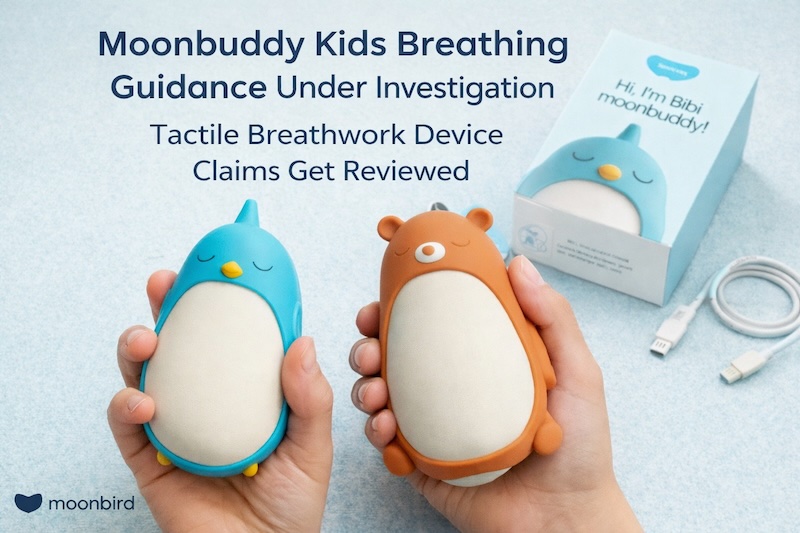
If you've been researching screen-free calming tools for children online, you've almost certainly come across Moonbuddy. The device continues to generate strong interest among parents, pediatric therapists, and educators — particularly those navigating bedtime resistance, childhood anxiety, and the growing cultural push to reduce children's screen time without sacrificing real tools that help kids self-regulate.
Moonbuddy, a handheld tactile breathing coach designed for children ages 6 to 12, has become one of the most frequently discussed products in the children's wellness space heading into 2026. With features in Forbes, Wired, Healthline, and a TIME Best Inventions of 2025 selection, the product has built significant visibility. With that visibility come real questions. Are the breathwork claims grounded in published research? How does the "calms kids in 4 minutes" positioning hold up against what the scientific literature actually supports? And does a device this simple justify the price point for families already stretched thin?
This overview is intended to provide general context on how the product is described and how it fits within the broader children's wellness category. It outlines what product materials describe, what research-level evidence supports regarding slow-paced breathing in children, and where gaps remain between marketing language and product-specific clinical evidence — so readers can better understand how the product is positioned within the category.
Current product details, pricing, and terms can be confirmed by viewing the current Moonbuddy offer (official Moonbuddy page).
Individual results vary. Children's responses to breathwork tools depend on factors including age, developmental stage, neurodivergent status, existing anxiety levels, and consistency of use. This article is informational and does not replace guidance from a pediatrician, child psychologist, or licensed therapist.
What Is Moonbuddy
Moonbuddy is a handheld, screen-free breathing device manufactured by Moonbird BV, a Belgian wellness technology company. The device is designed to guide children through slow-paced breathing exercises using tactile expansion and contraction — the device physically rises and falls in a child's hands, mimicking the rhythm of calm breathing so children can follow along without verbal instruction, screens, or app interaction.
Moonbuddy was developed after the adult Moonbird device (which retails separately) consistently ended up in the hands of customers' children. Co-founders Stefanie and Michael Broes adapted the technology with child-appropriate breathing rates, playful silicone sleeves featuring characters named "Barry the Bear" and "Bibi the Bird," and a simplified single-button operation with no companion app required.
The product is marketed through getmoonbuddy.io and also sold through the primary Moonbird website at moonbird.life. The official Moonbird shop lists the device at approximately $99.99. Bundle options include a starter pack and family pack at higher price points. Shipping and promotional terms vary — parents should verify current pricing on the official website before purchasing.
Published specifications list Moonbuddy at approximately 88 grams, with USB-C charging, automatic 4-minute sessions, and four pre-programmed breathing rhythms ranging from 6 breaths per minute to 10.5 breaths per minute. The different rhythms are indicated by colored lights — red, blue, green, and yellow — each designed for different age ranges and calming needs within the 6-to-12 target demographic.
The "Calms Kids in 4 Minutes" Claim: What Moonbuddy States vs. What Research Can Confirm
The central marketing narrative behind Moonbuddy connects the device to what product materials describe as breathing patterns based on established research into slow-paced breathing that activate a child's natural relaxation response. The product is positioned in connection with widely discussed parasympathetic nervous system activation techniques and is described as being backed by pediatrician and child therapist recommendations.
The scientific mechanism Moonbuddy's marketing describes — slow-paced breathing activating the parasympathetic nervous system — is a well-established concept in published physiological research.
Slow-paced breathing, generally defined as breathing at approximately 6 breaths per minute, has been studied extensively in adult populations. A 2025 study published in Scientific Reports (Nature) examined slow-paced breathing and found that it significantly increased heart rate variability (HRV) markers associated with parasympathetic activation, including RMSSD and high-frequency power, while reducing participants' heart rate. A separate 2024 systematic review and meta-analysis published in Mindfulness (Springer Nature) reported that slow-paced breathing was effective in reducing perceived stress and anxiety symptoms across multiple controlled studies, potentially by shifting autonomic balance toward greater parasympathetic dominance.
A narrative review published in 2025 examining 30 studies on structured breathing techniques found that HRV improvement was the most frequently reported physiological outcome, with 23 of 30 included studies showing significant improvements. Anxiety reduction was reported across 10 studies, and decreased perceived stress across 9 studies.
These findings come from research on the underlying breathing technique — not from studies evaluating Moonbuddy as a finished product. This is an important distinction that applies to all consumer devices built around established physiological principles.
Published product materials reference a 2025 pilot study involving 60 children, in which approximately 80 percent of daily evaluations reportedly rated Moonbuddy's effect as positive, and 78 percent of parents reported improvements in their child's sleep and wellbeing after one month. The product website notes that this study manuscript is currently under review. Until that research is published in a peer-reviewed journal and available for scrutiny, it should be understood as company-reported preliminary data rather than verified clinical evidence.
The referenced independent research by Aritzeta (2022) relates to slow-paced breathing in children broadly — not to the Moonbuddy device specifically.
Parents researching terms such as "Moonbuddy does it work," "Moonbuddy breathwork real results," "tactile breathing device for kids," or "Moonbuddy calm down tool" should understand that the research supporting slow-paced breathing as a calming technique is real and well-documented at the physiological level. However, the specific claim that Moonbuddy calms any child in 4 minutes represents the product's marketing positioning rather than a clinically validated outcome tested across diverse pediatric populations.
The Breathing Rhythms: What Moonbuddy Offers and How They Compare to Research Standards
Published help documentation describes four pre-set breathing rhythms designed specifically for children between 6 and 12 years old. Because children naturally breathe faster than adults, these rhythms are calibrated at slightly higher rates than the typical adult slow-breathing target of 6 breaths per minute.
The four modes, as detailed in published documentation, are as follows. The red light mode runs at 10.5 breaths per minute with a 2.8-second inhale and 2.8-second exhale. The blue light mode runs at 9 breaths per minute with a 2.8-second inhale, 0.4-second pause, and 3.5-second exhale. The green light mode runs at 8.5 breaths per minute with a 3.5-second inhale and 3.5-second exhale. The yellow light mode runs at 6 breaths per minute with a 5-second inhale and 5-second exhale.
Most published research on parasympathetic activation through slow-paced breathing has examined rates around 6 breaths per minute in adult populations. Fewer studies have specifically tested whether higher breathing rates — such as the 8.5 to 10.5 breaths per minute used in Moonbuddy's faster modes — produce the same parasympathetic shift in children. The product is described as having rates adapted for children's naturally faster resting respiratory rates, which is a reasonable physiological consideration, though the specific efficacy of each mode has not been independently validated through published research.
This doesn't mean the faster modes lack utility. It means that if you're comparing the device's breathing rates to published research, the strongest evidence base exists for the 6-breaths-per-minute range (yellow mode), while the faster modes represent an age-adapted design choice rather than rates validated in controlled pediatric breathing studies.
What Would Be Required to Demonstrate Effectiveness
This is one of the most useful questions any parent can ask about a children's wellness device — and it applies broadly, not just to Moonbuddy.
For a consumer wellness device to demonstrate effectiveness through clinical evidence, the standard generally includes a randomized, controlled study using the specific device in its intended population. The study would need to define measurable endpoints — such as changes in child-reported anxiety levels, observed sleep onset latency, cortisol measurements, or validated behavioral rating scales — and compare outcomes against a control group using either no device or a sham device.
Results would typically be published in a peer-reviewed journal and subject to replication. Published product materials reference a pilot study with 60 children that is currently under review for publication. If published, this would represent a meaningful step toward product-specific evidence, though pilot studies typically establish feasibility rather than definitive efficacy.
Understanding this distinction helps parents make purchasing decisions based on the actual evidence landscape. The underlying science of slow-paced breathing is well-supported. The application of that science through this specific device, at these specific breathing rates, in this specific pediatric population, has not yet been independently confirmed through completed peer-reviewed research.
Moonbuddy's Design: What Sets It Apart from Free Breathing Exercises
A question many parents ask — and one the product FAQ addresses directly — is why a child would need a device to breathe slowly when parents can simply teach deep breathing for free.
Product materials frame this through what is called "emotional training wheels." The tactile expansion and contraction is described as providing physical guidance that children's developing brains need to learn proper breathing rhythms without requiring the cognitive effort of following verbal instructions. The analogy is to training wheels on a bicycle — providing concrete physical scaffolding for a skill the child will eventually internalize.
This positioning has some support in developmental psychology. Research on children's self-regulation consistently shows that concrete, tactile tools tend to be more effective for younger children than abstract verbal instructions, particularly for children who are already in a dysregulated emotional state. The challenge of teaching a stressed child to "just breathe deeply" is something most parents recognize intuitively.
However, free alternatives exist. Belly breathing with a stuffed animal placed on the chest, five-finger breathing, and guided visualization scripts are all no-cost techniques used by child psychologists. The question for parents is whether a dedicated device meaningfully improves compliance and consistency compared to these alternatives — and that depends heavily on the individual child.
Moonbuddy Pricing and Purchase Structure
Pricing information published on the official Moonbird website at the time of this overview lists the standalone Moonbuddy device at approximately $99.99. Bundle options include a starter pack at approximately $229.99, a family pack at approximately $249.99, and accessories including a charging stand and travel case at approximately $29.99 each. Published information indicates that shipping is free on orders over $100.
The getmoonbuddy.io sales page, which serves as the primary direct-to-consumer funnel, may feature different promotional pricing or bundle configurations. Parents should verify current pricing and availability by viewing the current Moonbuddy offer (official Moonbuddy page) before purchasing.
All purchases are described as one-time payments with no subscriptions, no app fees, and no recurring charges. The device does not require a companion app — unlike the adult Moonbird device, which includes an optional app with guided exercises and biofeedback features.
Moonbuddy Refund Policy and Warranty
The published refund policy provides a 30-calendar-day return window from the date of receipt. The product is described as needing to be undamaged and in its original packaging to qualify for a return. Moonbuddy also comes with what is described as a 2-year warranty covering defects.
The refund policy indicates that once the returned item is received and inspected, refunds are processed within 30 calendar days. A free return shipping label is provided.
It is worth reviewing the complete return and refund terms directly on the official website before purchasing. Refund requests can be initiated by contacting support at hello@moonbird.life. Parents should retain all purchase confirmation details and original packaging.
Consumer Verification Checklist: What to Confirm Before Ordering
Separate breathing research from device research. Published studies on slow-paced breathing and parasympathetic activation are well-established. Fewer studies have specifically tested Moonbuddy as a finished product. Understanding this distinction helps set realistic expectations.
Consider your child's specific needs. Moonbuddy is designed for children ages 6 to 12. The product is not positioned as a medical device or a replacement for therapy. Children with clinical anxiety, ADHD, or other diagnosed conditions should be evaluated by a qualified professional before relying on any consumer wellness tool.
Verify current pricing and terms. Promotional pricing, bundle options, and shipping terms can change. Confirm all details on the official website before completing a purchase.
Review the refund policy independently. Understand the 30-day return window, condition requirements, and processing timelines before ordering.
Talk to your child's pediatrician or therapist. This is especially important for children currently receiving treatment for anxiety, sleep disorders, or emotional regulation challenges. Professional guidance should come before any wellness device purchase.
Who Might Consider Moonbuddy in 2026
Based on the product's published positioning and design, Moonbuddy may be of interest to parents looking for a screen-free, tactile calming tool that children can use independently as part of a bedtime routine or emotional regulation practice. The device's single-button simplicity and child-friendly design may be particularly appealing for families already committed to reducing screen time.
The product may be less suited for parents who require peer-reviewed, device-specific clinical evidence before purchasing wellness tools, those seeking solutions for clinical-level anxiety or sleep disorders that require professional treatment, or families for whom the price point presents a significant barrier relative to free breathing techniques.
Parents who have completed their own research and want to explore the full product details can do so. Complete product specifications, current pricing, and published terms are available by viewing the current Moonbuddy offer (official Moonbuddy page).
As with any children's wellness product, individual outcomes depend on a wide range of factors including the child's age, temperament, existing routines, and consistency of use. Published terms of use do not position Moonbuddy as a medical device and include a "No Medical Advice" disclaimer stating that the material provided is not intended as medical advice or a substitute for qualified healthcare guidance.
Consumer Questions About Moonbuddy
Is Moonbuddy scientifically proven?
The underlying principle — that slow-paced breathing activates the parasympathetic nervous system and can reduce anxiety — is supported by published peer-reviewed research in adult populations. Product materials reference a 2025 pilot study with 60 children that is currently under review for publication. Until that research is published and reviewed, the term "scientifically proven" as applied to the Moonbuddy device specifically represents the product's marketing positioning rather than a completed clinical validation.
Is Moonbuddy a medical device?
The published terms of use do not position Moonbuddy as a medical device. The terms include a disclaimer stating that the product is provided for general informational and wellness purposes only. Parents should not treat it as a substitute for professional evaluation or treatment of any medical or psychological condition.
What ages is Moonbuddy designed for?
Moonbuddy materials indicate the device is designed for children between 6 and 12 years old. The four breathing rhythms are calibrated for this age range. Because the breathing pace is tailored to children, the product is not recommended for adult use — the adult Moonbird device is designed separately for that purpose.
Does Moonbuddy use Bluetooth, WiFi, or screens?
No. Published specifications confirm that Moonbuddy operates entirely without WiFi, Bluetooth, screens, or a companion app. The device uses only tactile expansion and contraction plus colored LED indicators to guide breathing. This screen-free design means no blue light exposure during use.
What happens if my child does not like it?
The published refund policy provides a 30-calendar-day return window from the date of receipt, provided the item is in undamaged, original condition. A free return shipping label is included. Review the complete policy on the official website before purchasing.
Can Moonbuddy help with ADHD or neurodivergent children?
The product FAQ notes that tactile feedback may be particularly helpful for children with attention or anxiety challenges because it provides concrete physical guidance rather than abstract instructions. However, Moonbuddy is not positioned as a treatment for ADHD, autism, or any diagnosed condition. Parents of neurodivergent children should consult with their child's healthcare provider before introducing any new wellness tool.
How does Moonbuddy compare to breathing apps?
Moonbuddy's primary differentiator is its screen-free, tactile approach. Breathing apps require screen interaction, which introduces blue light and can be distracting for children who struggle with screen boundaries. The tradeoff is that apps typically offer more variety in guided exercises, tracking features, and customization. Parents should consider which approach better fits their child's needs and their family's screen time philosophy.
Where is Moonbuddy manufactured?
Moonbuddy is manufactured by Moonbird BV, a Belgian company. U.S. operations are listed at 3401 Garden Brook Dr., Farmers Branch, TX 75234, based on the terms of use published on getmoonbuddy.io.
Additional Consumer Research
Parents and consumers researching Moonbuddy may also benefit from reviewing published informational content on the adult Moonbird device, which uses the same core tactile breathing technology adapted for grown-up users. A 2026 informational overview examining Moonbird's guided breathing claims, EEG research references, and biofeedback features provides additional context on how the broader Moonbird technology platform is positioned within the consumer wellness category, including peer-reviewed research involving the adult device.
Reviewing multiple sources across the Moonbird product ecosystem may provide a more complete picture of the underlying technology, published research base, and how the company positions its devices for different age groups. Evaluating multiple sources is recommended before making any purchasing decision.
Contact Information
Email: hello@moonbird.life
U.S. Address: 3401 Garden Brook Dr., Farmers Branch, TX 75234
Phone: +32 493 56 83 59
View the current Moonbuddy offer (official Moonbuddy page)
Disclaimers
Content and Consumer Information Disclaimer: This content is provided for general informational purposes and reflects publicly available product information and category-level research. It does not constitute medical, health, parenting, or psychological advice. All product details, specifications, pricing, and policy terms described in this article are stated as presented on the company's publicly available website and product materials. This content has not been independently audited or verified unless specifically noted. Readers are encouraged to verify all claims directly with the manufacturer and to consult a qualified healthcare professional before introducing any wellness device into a child's routine.
Product and Wellness Notice: Published terms of use do not position Moonbuddy as a medical device. The product is not intended to diagnose, treat, cure, or prevent any disease or medical condition. Published terms state that the material provided is for general informational purposes only and is not intended as medical advice or a substitute for seeking advice from a qualified healthcare provider. Individual results vary based on numerous factors including age, developmental stage, existing anxiety levels, neurodivergent status, consistency of use, and overall family routine. Sleep and anxiety concerns in children should be discussed with a qualified pediatrician or child psychologist who is familiar with the individual child's history.
Results, Pricing, and Product Variability: All pricing, bundle offers, shipping terms, and refund policies referenced in this article are based on information published on the official product websites at the time of writing (April 2026) and may change without notice. Consumers should verify current terms through the official website before completing any purchase.
Research Context Disclaimer: Published studies referenced in this article examined slow-paced breathing techniques and parasympathetic nervous system activation as general physiological phenomena. These studies did not evaluate Moonbuddy as a finished consumer product. Product materials reference a 2025 pilot study that is currently under review for publication. Until published and reviewed, preliminary company-reported data should not be interpreted as completed clinical validation.
FTC Affiliate Disclosure and Publisher Responsibility: This article contains affiliate links. If a product is purchased through these links, a commission may be earned at no additional cost to the buyer. This compensation does not influence the accuracy, neutrality, or integrity of the information presented. All descriptions are based on published research, publicly available product information, and official website disclosures. The publisher of this article is not responsible for typographical errors, manufacturer changes to the product after publication, or individual consumer outcomes.

Email: hello@moonbird.life
Phone: +32 493 56 83 59