THE SYSTEM IS MISPRICED. The Pre-Diagnostic Index™ (PDI) Reveals the Structural Cost of the Gap
PR Newswire
MINNEAPOLIS, May 4, 2026
The Pre-Diagnostic Index™ (PDI), quantifies the structural cost of unmeasured behavioral health risk at $515 per member annually - derived exclusively from published federal and peer-reviewed data.
MINNEAPOLIS, May 4, 2026 /PRNewswire-PRWeb/ -- A newly released, payer-defensible model developed from published federal and peer-reviewed data shows the U.S. healthcare system is carrying $515 million in annual structural exposure per one million members, driven by the absence of a pre- diagnostic measurement standard in behavioral health. This exposure is now quantified through the Pre-Diagnostic Index™ (PDI), derived exclusively from published, peer-reviewed, and government data. https://theoxygenplan.com/
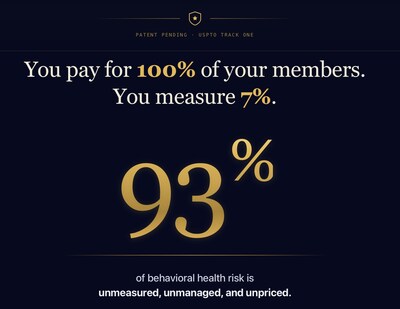
Depression screening occurred in only 4.2% of primary care visits among adults without a known diagnosis, based on nationally representative medical record data from the National Ambulatory Medical Care Survey (NAMCS) and the U.S. Preventive Services Task Force's systematic evidence review. At a 4.2% documented screening rate, 95.8% of adults in the primary care population without a known behavioral health diagnosis receive no structured measurement.
Applying the nationally documented 8.4% prevalence of major depressive disorder (MDD) to the unscreened population yields approximately 80,000 adults per one million covered lives experiencing depression outside any structured screening environment. Each of those individuals carries $6,404 annually in direct healthcare costs — the documented healthcare cost component of the $16,854 per-person total incremental burden of MDD (Greenberg et al., Advances in Therapy, 2023; PMC10499687). Using only the direct healthcare cost component — 38.1% of total burden — keeps the model conservative and payer-defensible.
These costs are not caused by clinical failure, provider shortage, or access gaps. They are caused by the absence of a pre-diagnostic measurement substrate — the layer that would make risk visible before crisis, route it before escalation, and price it before it becomes a claim. Without it, the system measures too late, routes too late, and pays too much.
The gap is architectural.
The cost is invisible.
The exposure is structural.
Every system that manages risk at scale begins with a measurement substrate. Before GPS, logistics wasn't a routing problem — it was a coordinate system problem. Before FICO, lending wasn't a capital problem — it was a risk-scoring problem. Before LOINC, labs weren't a testing problem — they were an interoperability problem. Behavioral health is following the same trajectory: not a care gap, but a pre-diagnostic measurement gap.
The scale of exposure is consistent across populations. A 10,000-life employer carries approximately $5.15 million in annual exposure. A 100,000-life payer carries approximately $51.5 million. A one-million-life plan carries $515 million, or $42.95 per member per month.
The system is not underperforming.
It is mispriced.
All cited sources, methodology, and a live calculator are publicly available at www.theoxygenplan.com
About The Oxygen Plan Corporation
The Oxygen Plan Corporation develops patent-pending O2OS™ — a pre-diagnostic measurement, routing, reimbursement, and governance architecture for behavioral health featuring its clinically validated Stress Number™. Foundational disclosures date to 2008 prior art, with peer-reviewed clinical validation conducted working in collaboration with Mayo Clinic.
Media Contact
Chris Lechuga, The Oxygen Plan Corporation, 1 1 877 897-6520, chris@rockerpr.com, https://theoxygenplan.com
 View original content to download multimedia:https://www.prweb.com/releases/the-system-is-mispriced-the-pre-diagnostic-index-pdi-reveals-the-structural-cost-of-the-gap-302760894.html
SOURCE The Oxygen Plan Corporation